Login
Login
Book a Demo
Book a Demo



There’s a lot of talk about artificial intelligence transforming software testing — particularly in healthcare. Phrases like “autonomous testing” and “AI-driven QA” are making the rounds in vendor decks and tech blogs. But in the real world of clinical software and regulated Health IT environments, the gap between hype and practical application remains significant.
As we noted in the last blog post, even basic automated testing is far from ubiquitous. In fact, Forrester’s 2024 Developer Survey — based on responses from over 2,300 developers — reveals that automation still accounts for less than 25% of all testing activities, even in general software development environments:
And that’s in settings without regulatory documentation requirements, validation protocols, or the clinical risk burden that healthcare IT teams manage daily.
The bottom line: If automation hasn’t yet transformed software development, it’s not going to revolutionize clinical validation workflows overnight — and AI won’t either.
That said, AI isn’t smoke and mirrors. It’s already showing up in useful ways — particularly in supporting manual testing workflows, not replacing them.
One of the most promising applications is test case and test script generation. Generative AI tools can scan requirement documents, configuration specs, data collection worksheets, and output files to draft initial functional test scripts. This can save hours of upfront effort, especially for common workflows and routine validations.
This doesn't eliminate the need for human testers. In fact, the AI-generated content still requires thorough review and often rework. Why? Because most large language models weren’t trained in the clinical domain. They don’t know what an “interfaced instrument” is. They can’t distinguish between a LIS workflow and an EHR integration. Without that context, their output remains generic.
But as a starting point — a way to get 60% of the way there, faster — AI is useful.
This time-saving measure frees up testers to focus on more strategic, complex work — like scripting end-to-end workflows, evaluating risk, and performing the UAT testing.
IDC recently predicted that by 2028, generative AI tools will write 70% of software test scripts. That’s a meaningful shift — but it doesn’t mean testing will be fully automated or that testers will become obsolete.
What it means is this: testers may spend less time drafting scripts from scratch and more time executing, refining, and interpreting results. AI may take over the blank page. It won’t take over testing judgment — especially in a regulated environment.
For clinical labs, middleware vendors, and healthcare IT teams, the path forward is incremental, not revolutionary:
AI, when applied strategically, will help teams scale. But only if it’s embedded within a framework that protects clinical integrity, regulatory compliance, and operational reliability.
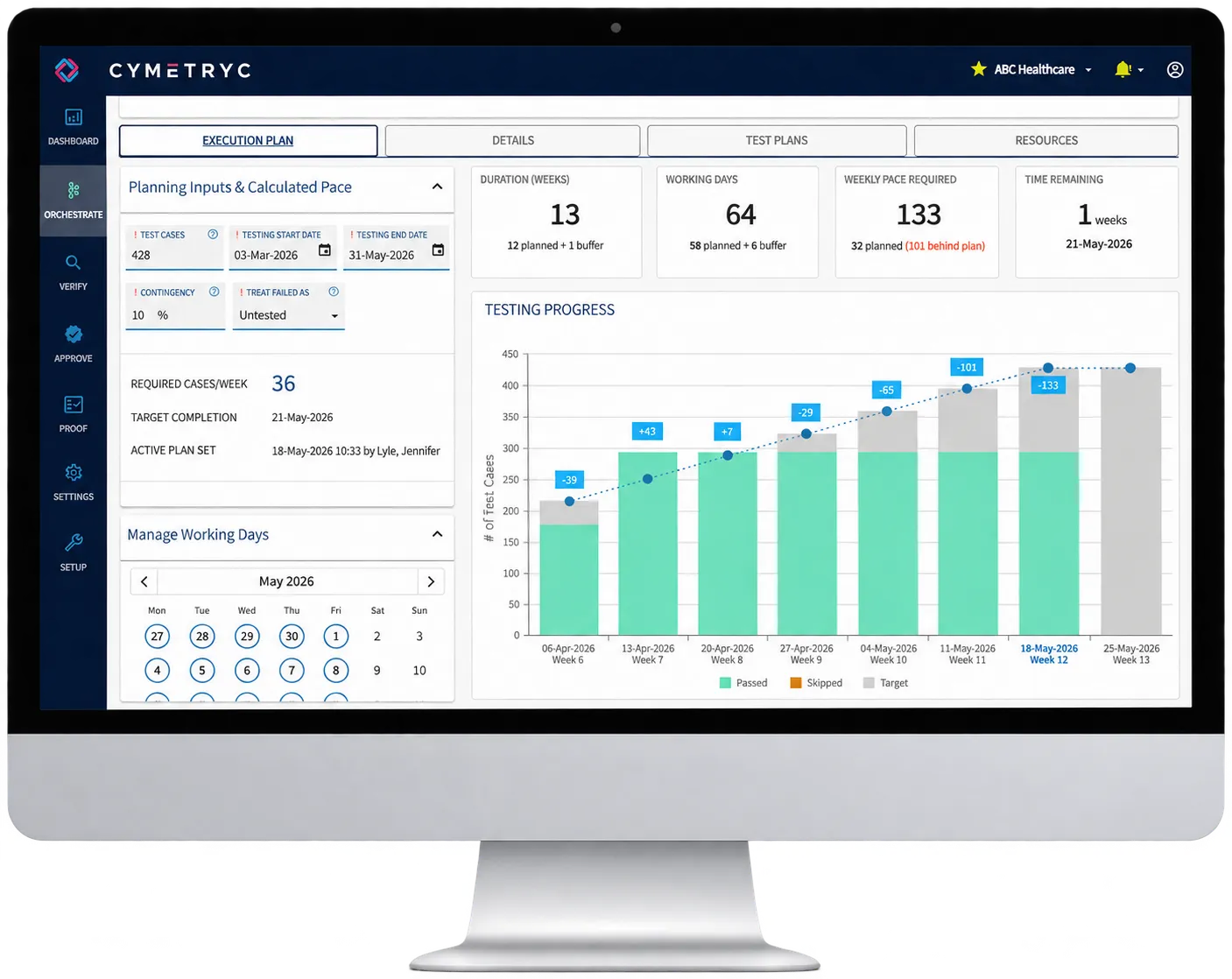
Cymetryc is designed for exactly this kind of environment: where repeatability, traceability, and context matter. Our platform brings structure and visibility to your UAT and validation efforts — and we’re actively integrating AI tools that accelerate testing without compromising oversight.
We believe AI will augment — not replace — the testing process. And in healthcare, that’s exactly how it should be.
Let us know if you're exploring how to scale your validation capacity without losing control of quality.

Security & compliance
SOC 2
Type 2
ISO
27001:2022
HIPAA
Compliant
GDPR
Compliant