April 8, 2026
2 min read

Epic I: The Awakening

Epic I: The Awakening
FOLLOW US

Why most Beaker projects are underestimated from day one

Most Epic Beaker projects start the same way.

At the executive level, it's a strategic decision:

"We're moving to Beaker."

It makes sense. Standardization. Integration. Long-term efficiency.

But what doesn't get fully understood at that point is what comes next.

Because once the decision is made, the timeline is set. And it's not flexible. Epic's Clinical Content Validation (CCV) process is already mapped out:

CCV1 → CCV2 → CCV3

And each phase carries increasing weight:

  • CCV1: build review and clinical correctness
  • CCV2: functional workflow testing with evidence
  • CCV3: full end-to-end validation across instruments, middleware, blood bank, and downstream systems

On paper, it looks structured. Manageable, even. In reality, this is where the scale begins to reveal itself. Because CCV is only part of the story.

Alongside it, teams are often also responsible for:

  • Mapped Record Testing (MRT) to ensure that laboratory data is accurately transmitted and formatted for integration into patient records
  • Blood bank system implementation or integration, with its own regulatory rigor and validation requirements
  • Interface validation across middleware, analyzers, and external systems
  • Parallel projects that don't slow down just because Beaker is happening

The expectation is simple:

You will be ready to go live.

That responsibility doesn't land on executives. It lands on:

  • Lab IT
  • Lab Operations
  • Medical directors
  • SMEs who are still running the lab every day

And for many of them, this is the first time they've gone through a full LIS implementation. There's always a moment, early in the process, where it clicks:

"This is much bigger than we thought."

Because CCV is not just "testing." It's:

  • Translating thousands of rows from Epic build spreadsheets into executable test cases
  • Validating every rule, reference range, calculation, and result pathway
  • Capturing step-level evidence, often hundreds of screenshots per tester per day
  • Logging and managing defects that must be resolved and retested
  • Coordinating approvals across lab, IT, and clinical leadership
  • Producing documentation that will stand up to CAP, CLIA, or ISO inspection

And all of this is happening while:

  • SMEs are pulled back into daily lab operations
  • timelines continue moving forward
  • testing volume compounds across disciplines and sites
  • and additional efforts like MRT and blood bank validation run in parallel

This is where most Beaker journeys actually begin. Not with testing. But with realization.

  • How much needs to be tested
  • How structured it needs to be
  • How much evidence needs to be captured
  • And how little time there is to figure it out

Beaker projects don't struggle because teams don't care. They struggle because the scale isn't fully visible until it's already underway.

No one sets out to underestimate it. But almost everyone does.

Next in the series: Epic II: The Ordeal
Latest from the blog

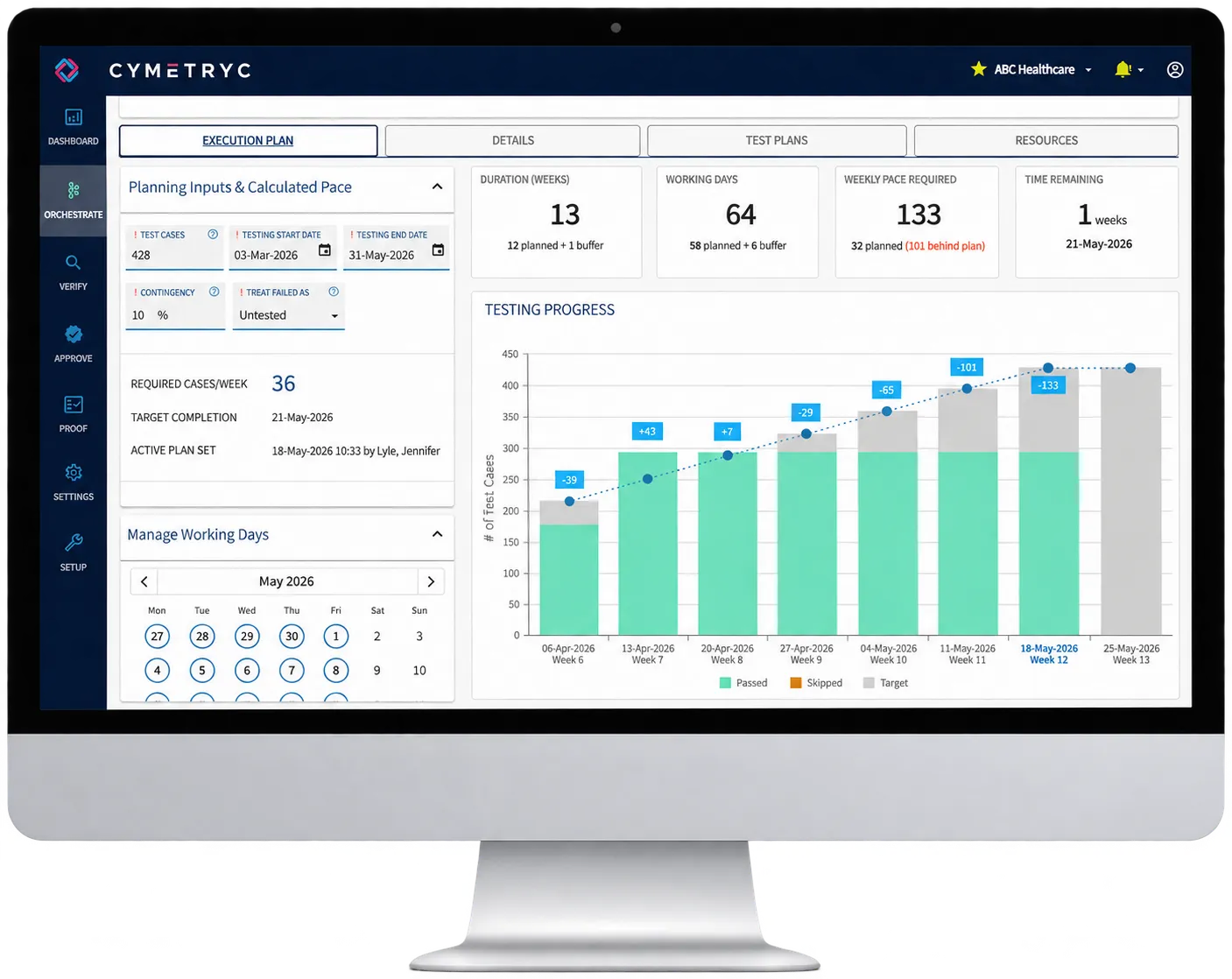
Cymetryc execution plan showing planning inputs, calculated weekly pace and testing progress on a desktop monitor