Login
Login
Book a Demo
Book a Demo



Stockport NHS Foundation Trust's successful WinPath deployment offers a useful reminder: the quality of a go-live is often determined long before the system reaches production.
A remarkably smooth LIMS go-live does not happen by accident.
Stockport NHS Foundation Trust recently completed the deployment of Clinisys WinPath, replacing a laboratory system that had been in place for more than 30 years. The scale of the programme was significant. Stockport's pathology services process more than 9.2 million blood sciences tests annually, approximately 31,000 each day, alongside substantial microbiology, cellular pathology and transfusion workloads. The implementation also included the migration of around 30 years of transfusion data.
For an organisation operating at that volume, even a relatively small disruption can affect large numbers of samples, clinicians and patients. Yet Stockport reported that the system performed as expected from the outset, with only minor issues raised during go-live.
That outcome deserves attention, not simply because the project was successful, but because it illustrates what thorough preparation can achieve.
When a major health IT implementation goes badly, the consequences are highly visible. Workarounds appear, support calls escalate, results are delayed and project teams move rapidly into recovery mode.
When a go-live goes well, very little appears to happen.
Systems function. Staff continue working. Results move through the expected pathways. Problems are limited and manageable. From the outside, it can look almost routine.
But "routine" is rarely an accurate description of the work that came before it.
Stockport deliberately divided its WinPath implementation into two phases. Microbiology and cellular pathology went live first, followed by the more complex blood sciences and transfusion phase. The decision was made to reduce operational risk, protect patient safety and avoid combining too many major changes at once.
This was not merely a technical deployment strategy. It was a risk-management decision grounded in the realities of running high-volume clinical services while replacing a mission-critical system.
One of the most important comments in the Stockport account came from Mark Gordon, Associate Divisional Director for Pathology.
He attributed the team's confidence going into the transition to the level of testing that had been completed and said that preparation paid off during go-live.
That is a simple statement, but it captures the real purpose of user acceptance testing.
Testing is not just about completing a spreadsheet, recording a pass or reaching a target percentage. It is the process through which an organisation earns confidence that the new system will support its actual workflows, users and clinical responsibilities.
That means exercising the paths through which orders, specimens and results move. It means confirming that interfaces behave correctly, rules fire as expected and information is displayed accurately to the people who rely on it. It also means identifying failures early enough to resolve and retest them before the system is carrying live patient data.
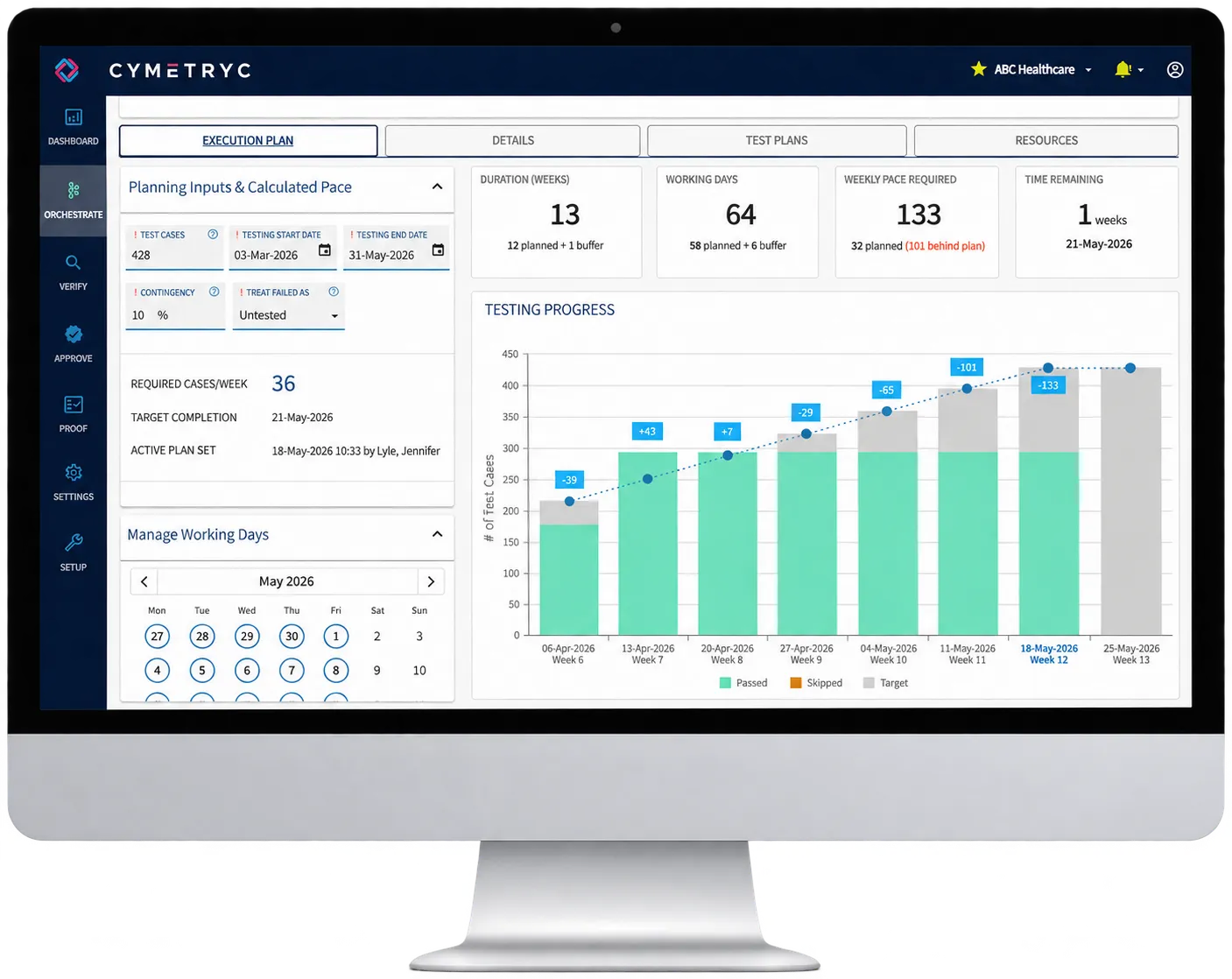
Stockport used Cymetryc to plan, manage and document this testing programme. Our team had the opportunity to see the amount of preparation, discipline and collaboration behind the outcome described in the article.
The smooth go-live was not evidence that the project encountered no problems. It was evidence that the team had created a structured way to find and address problems before they became production incidents.
A LIMS does not function as a standalone application. It sits within a network of analysers, middleware, electronic patient records, order communications systems and external users.
Stockport's programme included extensive end-to-end testing as well as detailed validation of the migrated transfusion data. Large-scale data reviews and sampling were used to confirm accuracy and compliance before go-live.
This is where many implementation programmes become difficult. A workflow may function correctly within one application but fail when data crosses into another system. A result may calculate correctly but display differently downstream. A configuration change may solve one issue while unintentionally affecting another pathway.
End-to-end testing is how the organisation confirms that the entire chain works, not merely each individual component.
It also depends heavily on the participation of people who understand the real clinical workflow. Vendors and project teams bring essential technical and implementation expertise, but only the users who perform and oversee the work can confirm whether the system behaves appropriately in their environment.
The Stockport story also included a point that every major programme should take seriously: successful implementation requires the right people, the right expertise and enough time allocated from the beginning.
Laboratory subject matter experts are often expected to support testing while continuing to meet the demands of their normal roles. Business-as-usual work does not stop simply because a major digital programme is underway.
Without realistic resource planning, testing becomes compressed into shorter windows, approvals accumulate at the end and people are placed under pressure to move quickly through work that requires concentration and judgement.
Technology can streamline the process, eliminate unnecessary administration and improve visibility. It cannot remove the need for knowledgeable people to assess whether the system is clinically correct.
That human judgement remains central.
The success of a testing programme is not demonstrated by the number of scripts completed. It is demonstrated by what happens when the system enters live use.
Did the workflows perform as expected?
Were significant issues already known and resolved?
Could the team explain what had been tested and provide the supporting evidence?
Was the organisation able to maintain service continuity while moving onto the new platform?
In Stockport's case, the answer appears to have been yes. A system supporting approximately 31,000 blood sciences tests each day went live with minimal disruption and only minor issues.
That is not simply a successful technology deployment. It is a strong example of testing, governance, communication and implementation planning working together.
A quiet go-live may not look dramatic. For a pathology service, that is the best possible result.
Read the full Stockport NHS Foundation Trust story.

Security & compliance
SOC 2
Type 2
ISO
27001:2022
HIPAA
Compliant
GDPR
Compliant