Login
Login
Book a Demo
Book a Demo




At the recent White House health tech event, CMS and more than 60 organizations—including Amazon, Epic, Apple, Google, and OpenAI—committed to modernizing healthcare with better data infrastructure, interoperability, and patient-facing digital tools.
The goal:
In a standout video, Amy Gleason, strategic advisor to HHS & CMS shared how uploading her daughter’s records into an AI assistant revealed a long-missed diagnostic discrepancy. It may open the door to a clinical trial after 15 years of waiting.
“Let’s stop accepting what’s broken and start building what works.”
That message resonates beyond AI and patient apps. It applies directly to how we manage testing and validation for the systems behind clinical care.
Too many teams still rely on:
These methods weren’t built for today’s complexity, pace, or staffing realities. They're hard to scale, hard to manage, and often delay go-lives. And with growing regulatory expectations and leaner teams, we no longer have time to work around inefficient tools.
Upgrading your platform is only part of the solution. Validation needs to evolve from the inside out. Here’s what that means:
1. Risk-Based Prioritization
Not every function or integration needs the same level of testing. Risk-based validation means asking:
These are the questions at the heart of Computer Software Assurance (CSA) – the FDA's shift away from documentation-heavy Computer System Validation (CSV) toward a more modern, risk-based approach. CSA encourages:
You can read the FDA's draft guidance on CSA here: 📄 FDA CSA Draft Guidance
Although CSA is designed for manufacturing and quality systems, its principles apply equally to lab systems, middleware, EHR modules, and other regulated health IT environments.
2. Fit-for-Purpose Tooling
There’s no one-size-fits-all solution. The right mix often includes:
Spreadsheets and folders are too fragile for this. Testers and approvers need a platform that helps them work efficiently and accurately, not just document effort.
3. Clinician-Friendly Approvals
Clinical users need to see the right information, at the right time, in the right format. That means:
Making the process easy for clinicians improves both engagement and quality of review.
4. Continuous Readiness
Testing is no longer a quarterly or annual project. With frequent upgrades, integrations, and releases, validation needs to be ready when the next go-live or inspection arrives.
That includes:
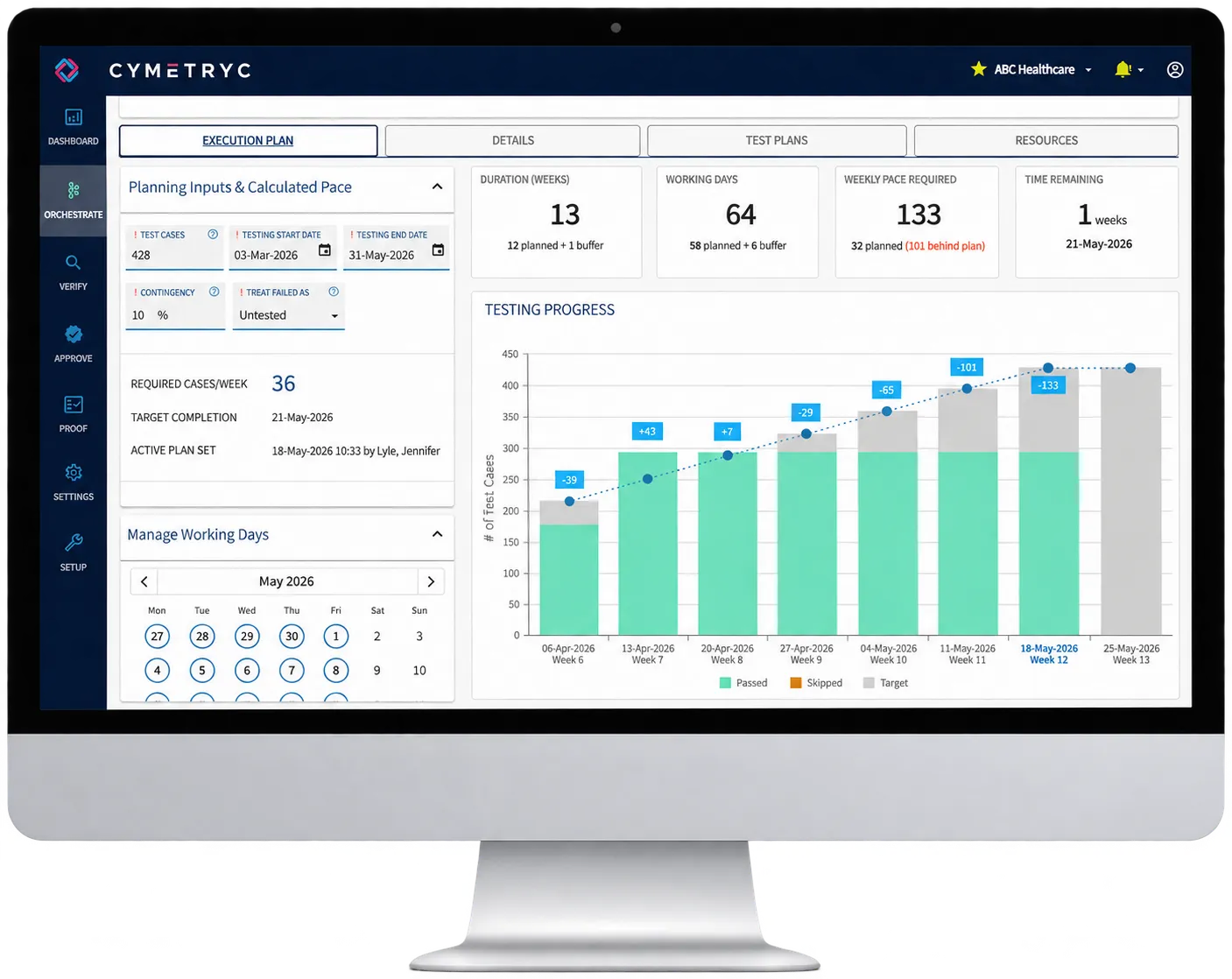
Tools like Cymetryc are helping health IT teams catch issues earlier, reduce test effort by up to 40 percent, and deliver the visibility and control needed to eliminate delays and uncertainty caused by disconnected, disparate tools.
But this shift isn’t just about technology. It’s about leadership.
Validation doesn’t have to be a bottleneck. It can be faster, more collaborative, and more meaningful. And it must be—especially as we step into the era of AI, where trust in the systems behind the data becomes more critical than ever.

Security & compliance
SOC 2
Type 2
ISO
27001:2022
HIPAA
Compliant
GDPR
Compliant