Login
Login
Book a Demo
Book a Demo


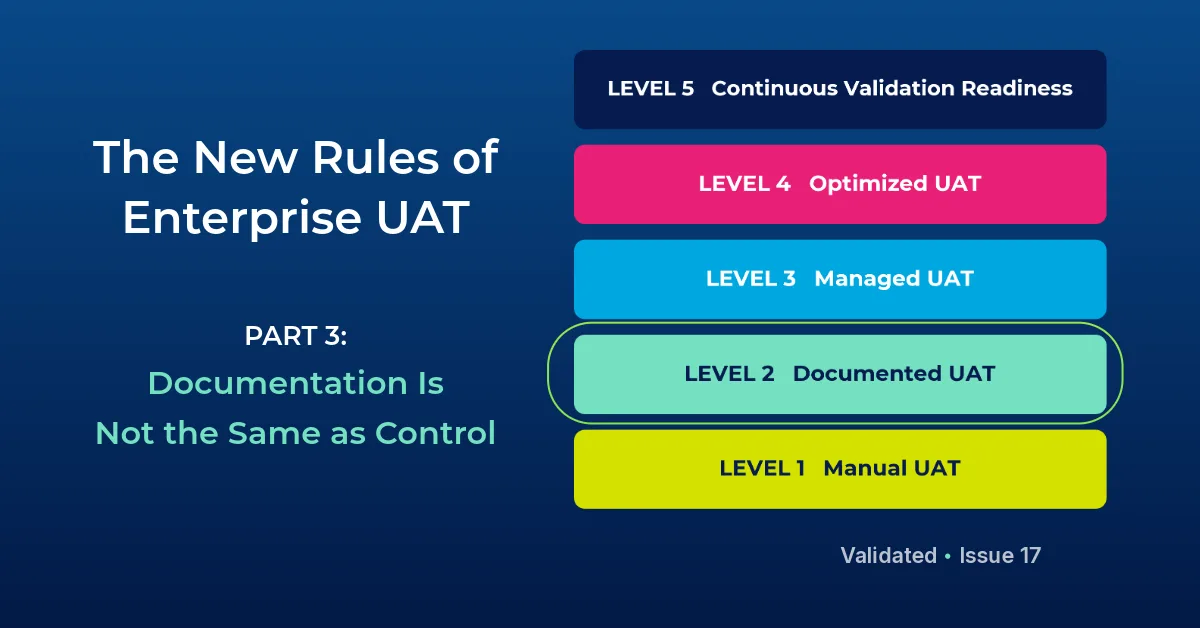

The New Rules of Enterprise UAT – Part 3
In the last article in this series, we looked at Level 1 of the Enterprise UAT Maturity Model: Manual UAT. Manual UAT is not a failure. It is a maturity stage. It is what happens when good teams use the tools they already have: spreadsheets, shared folders, screenshots, email threads and status meetings.
The problem is that manual UAT does not scale well once the work involves multiple departments, sites, workflows, vendors, integrations, approvers or regulatory expectations. At that point, the testing process depends on too much invisible effort. Someone has to update the tracker, chase missing evidence, connect issues back to test cases, confirm retesting and assemble the final record after the fact.
The natural next step is documentation. Teams introduce standard templates, written procedures, test plans, sign-off forms, evidence requirements and basic traceability. That is progress. It brings structure where there was previously too much improvisation.
But it also introduces the next rule of Enterprise UAT:
Documented UAT is Level 2 of the Enterprise UAT Maturity Model. It is a meaningful step forward from purely manual testing because the organization has started to define how UAT should be done. There may be standard test plan formats, expected evidence, written instructions, defined roles and a clearer understanding of what needs to be approved before go-live.
For smaller or lower-risk projects, that level of structure may be enough. A documented process can help a team avoid obvious gaps and create a record that testing occurred. It also gives project managers and reviewers something more concrete to work from than memory, meeting notes or a loosely maintained spreadsheet.
The trap is that documentation can make a process look more mature than it really is. A folder full of test plans, screenshots and sign-off documents may suggest control, but it does not necessarily prove that the process was controlled while the work was happening.
Documented UAT often feels better because it is more orderly. There are templates. There is a process. There are files in a shared location. There are trackers with status columns. There may be a written procedure that explains what testers should do, what evidence should be captured and who needs to approve the results.
All of that matters, especially in regulated or business-critical environments. No one wants a UAT process that lives entirely in people's heads. Documentation creates consistency, helps onboard new testers and gives teams a repeatable starting point.
But documentation by itself is static. It describes the process or records the outcome, but it does not necessarily help leaders manage the work in real time. A documented process may still rely on manual updates, separate issue logs, disconnected evidence folders and approvals that happen only after someone assembles the right package.
That is why Level 2 can be deceptively comfortable. It feels organized, but it may still be fragile underneath.
One of the most common signs of Documented UAT is that evidence collection becomes a second job layered on top of testing. Testers perform the workflow, capture screenshots, save files, update a spreadsheet, write notes and then hope everything is stored in the right place. If the system under test is complex, the documentation burden can become almost as consuming as the testing itself.
This is especially true when the testers are not professional software testers. In many enterprise UAT efforts, the people performing the work are clinical users, operational leaders, analysts, finance users, HR users, lab staff or other subject matter experts who already have full-time responsibilities. They are asked to validate a system because they understand the real workflow, not because documenting software testing is their primary job.
That distinction matters. If the documentation process is too cumbersome, it distracts the very people the organization most needs to focus on whether the system behaves correctly. A tester who is fighting with screenshots, folders and formatting has less attention available for observing the workflow, questioning an unexpected result or noticing something that does not align with real-world practice.
The goal should not be to make people document more. The goal should be to make the testing process naturally produce the evidence needed to support review, approval and readiness decisions.
Documented UAT also tends to expose a traceability gap. A team may have test cases, evidence, issues and approvals, but those pieces may not be tightly connected to one another. The test case may live in a spreadsheet. The evidence may live in a folder. The defect may live in an email thread or a separate tracker. The approval may live in a signed document. Each artifact exists, but the story is fragmented.
That fragmentation becomes a problem when someone needs to understand what actually happened. If a test failed, can the team see the original evidence? Can they see who reviewed the issue, what was changed, when it was retested and who accepted the final outcome? If an approver has a concern, can they quickly see the full context without sorting through several locations? If an auditor, inspector or project sponsor asks how readiness was determined, can the team show the evidence without reconstructing the project from pieces?
In a mature UAT process, traceability should not require detective work. The test, evidence, issue, resolution, retest and approval should be connected as part of the process.
Another limitation of Documented UAT is that status may still be difficult to trust. A spreadsheet can show that a test case is complete, but it may not show whether the evidence is sufficient, whether an issue is still open, whether retesting occurred or whether the appropriate reviewer has approved the result. A weekly status report can summarize progress, but it may already be out of date by the time it reaches the project team.
This creates a dangerous gap between documented status and actual readiness. Leaders may see a testing percentage and believe the project is on track, while unresolved issues, incomplete evidence or delayed approvals are sitting underneath the surface. The project may appear documented, but not truly managed.
For business-critical systems, that distinction matters. An EHR, LIS/LIMS, Order Comms platform, PACS, middleware, ERP, HRIS, Workday or QMS implementation does not become ready simply because the testing tracker looks complete. Readiness depends on whether the right workflows were tested, whether the evidence supports the outcome, whether failures were addressed and whether accountable reviewers had enough context to approve.
Documentation helps record readiness. It does not automatically create it.
Approvals often reveal the difference between documentation and control. In a Documented UAT process, approval may still happen at the end, after testing is complete and evidence has been assembled. That can create a heavy burden for reviewers, especially when there are hundreds or thousands of test cases.
Reviewers need more than a pass/fail status. They need context. They need to understand what was tested, what evidence was captured, what issues occurred, whether those issues were resolved and whether the result is acceptable for go-live. If that context is spread across spreadsheets, documents, screenshots and email chains, approval becomes slower and less meaningful.
This is not just an administrative problem. Approval is an accountability step. In regulated areas, it may also become part of the compliance record. A process that makes approval difficult increases the risk that reviewers either delay the project or approve without fully understanding the underlying evidence.
A stronger UAT process should make approval easier without making it superficial. The reviewer should be able to see the full testing context in one place and make a timely, informed decision.
The biggest danger of Documented UAT is that it can hide risk behind process artifacts. The presence of documentation can make leaders feel reassured even when the process still depends on manual reconciliation, delayed updates and disconnected evidence.
A test plan is useful, but it does not guarantee that testing was completed properly. A screenshot is useful, but it does not guarantee that the expected result was understood. A sign-off is useful, but it does not guarantee that the reviewer had full context. A status report is useful, but it does not guarantee that the project team can see what is happening right now.
This is why Level 2 is both important and incomplete. It is a necessary step away from manual chaos, but it is not the destination.
Good documentation should support the work, not weigh it down. It should make testing easier to follow, evidence easier to capture, issues easier to understand and approvals easier to complete. It should give leaders a reliable record of what happened without forcing the team to rebuild that record after the fact.
At its best, documentation creates consistency. It helps ensure that teams test the right things, capture the right evidence and involve the right reviewers. It also helps organizations reuse knowledge from one project to the next, instead of starting over every time a system is upgraded, replaced or reconfigured.
But documentation reaches its limit when it is treated as the main control mechanism. Once systems become more complex, more integrated or more heavily regulated, organizations need more than a documented process. They need visibility into the process while it is happening.
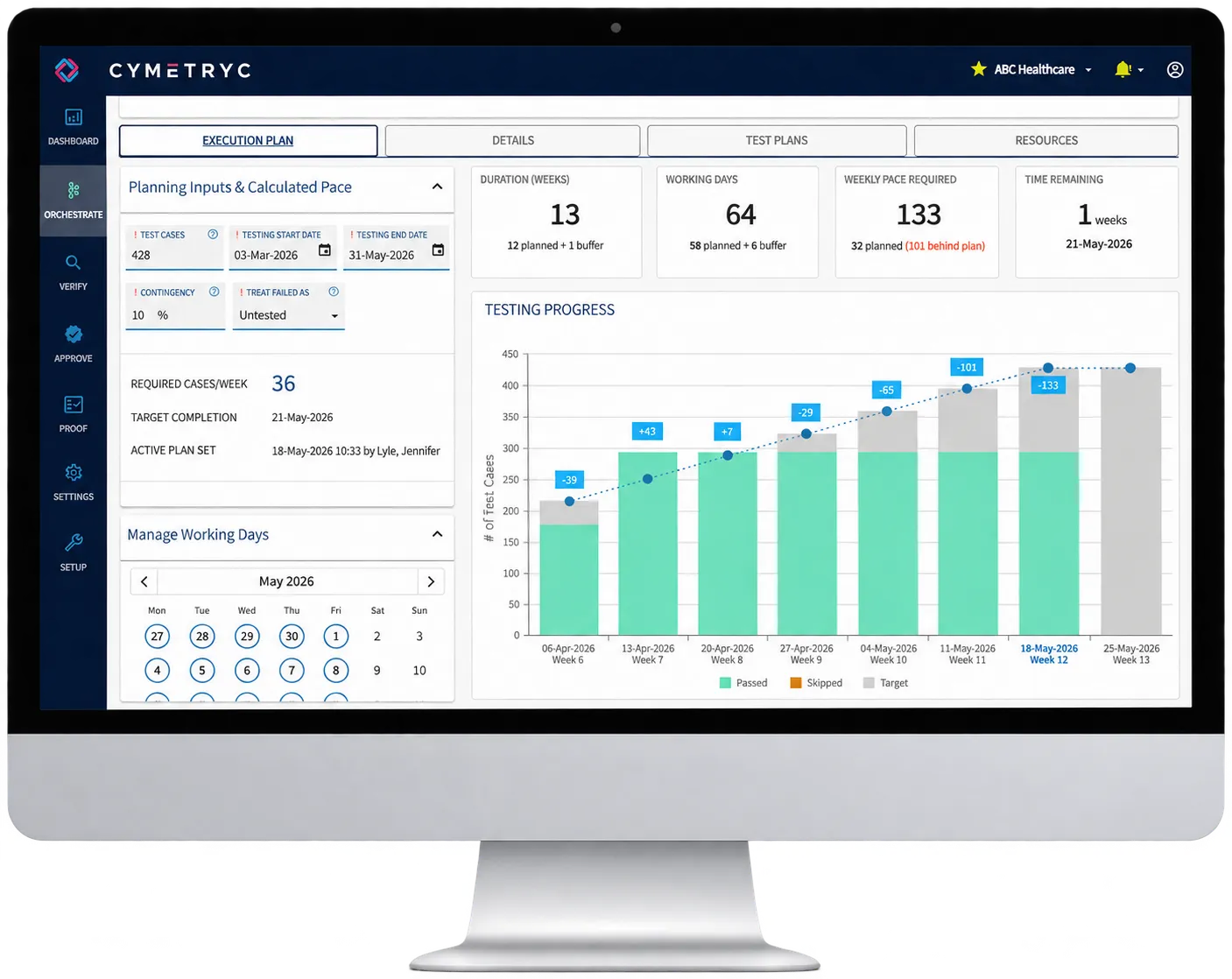
The next stage in the Enterprise UAT Maturity Model is Managed UAT. This is where UAT begins to move from static documentation to active control. Testing work is centralized. Progress is visible. Issues are connected to test cases. Evidence is captured as part of execution. Approvals can happen closer to the work. Project leaders can see what is complete, what is blocked, what is failing and what still needs attention.
This is where UAT starts to become a real management discipline rather than a documentation exercise.
Documented UAT is an important step. It brings structure, consistency and a more reliable record. But documentation alone cannot tell leaders whether the project is truly under control.
That is the focus of the next article in this series.
Because once the system carries enough risk, UAT needs to be managed in real time, not reconstructed at the end.

Security & compliance
SOC 2
Type 2
ISO
27001:2022
HIPAA
Compliant
GDPR
Compliant