Login
Login
Book a Demo
Book a Demo




In the first two parts of this series, I wrote about how Epic Beaker projects are often underestimated at the start, and how the real challenge quickly becomes managing the work, not simply doing the testing.
This third part is about what happens when the full scale finally comes into view.
At a certain point in a Beaker implementation, the work can no longer be understood as "a lot of testing." That phrase is too small for what is actually happening. The effort becomes a large operational event, with thousands of interdependent activities moving across lab operations, lab IT, build teams, application teams, project management, clinical leadership and quality.
In other words, it becomes an avalanche.
Not because the project was poorly planned. Not because the lab team did anything wrong. And certainly not because people are not working hard enough.
It happens because the amount of work begins to exceed what traditional tools can realistically control.
In one large integrated health system we are currently supporting, the team is still in CCV2 and already managing more than 12,500 test cases and nearly 46,000 test steps. More than 500 issues have been documented, and thousands of testing activities remain ahead.
And this is still before the full weight of CCV3 has landed.
That matters because CCV3 is where Beaker validation moves even deeper into the laboratory's operational reality. CCV2 already requires functional workflow testing, evidence capture, defect documentation and review. But CCV3 stretches across analyzers, middleware, blood bank workflows, reference laboratory connections, downstream systems and the patient record. This is where the lab must clinically verify that information is moving correctly across the full ecosystem.
And that work does not happen in a quiet conference room set aside for testing.
It happens while lab operations teams are still responsible for running the lab every day.
That is the part many project plans do not fully convey. The volume is not just numerical. It is operational. Every test case represents someone who has to understand the workflow, execute the steps, capture evidence, document the outcome, respond to failures and often come back later to retest. Every defect has to be communicated clearly enough for someone else to understand it, work it, correct it and prove that the correction held. Every approval depends on documentation being complete, organized and reviewable.
And while all of this is happening, the implementation timeline continues to move.
Epic's timelines generally do not pause because testing uncovered more defects than expected, because lab operations is still working through evidence, or because the remaining validation effort is larger than anyone originally anticipated. The go-live date is typically treated as fixed, regardless of where testing actually stands.
That creates a very real pressure point for the laboratory.
When the numbers get large enough, the risk is not just that people fall behind.
The bigger risk is that the organization loses the ability to see the work clearly.
That is where issue management becomes especially important. In a smaller project, teams can sometimes get by with informal communication, screenshots saved in folders, notes in spreadsheets and conversations on project calls. It is not ideal, but it may appear to hold together.
At Beaker scale, that approach starts to break.
When hundreds of issues are being identified, the question is not simply how many are open. The more useful questions are where the issues are clustering, which workflows are repeatedly failing, which defects are ready for retesting, which ones are blocked, who owns the next action and whether the evidence is tied cleanly to the original failure and retest.
Those questions matter because validation is not just about finding defects.
It is about proving that defects were handled appropriately.
A failed test is not automatically a bad thing. In many ways, failed tests are the point of testing. They show that the process is doing what it is supposed to do: exposing gaps before go-live. The real risk comes when failures are disconnected from the evidence, issue discussion, resolution and retesting. That is where teams lose traceability. And in a regulated laboratory environment, traceability is not optional.
This is also where leadership visibility becomes critical. A status report that says testing is "62% complete" may sound reassuring, but it does not tell leadership enough to make good decisions.
Complete where? Which areas are behind? How much effort remains? Where are the highest-risk workflows? How many issues are waiting on build correction, and how many are ready for retest? Which areas need more resources before the timeline is at risk?
Without that level of visibility, teams end up managing by anecdote. The loudest issue gets attention. The most vocal group gets support. The areas that look quiet may actually be stuck. This is not a criticism of the people involved. It is what happens when the work becomes too large to see clearly.
This is where the visibility from a purpose-built validation platform changes the conversation.
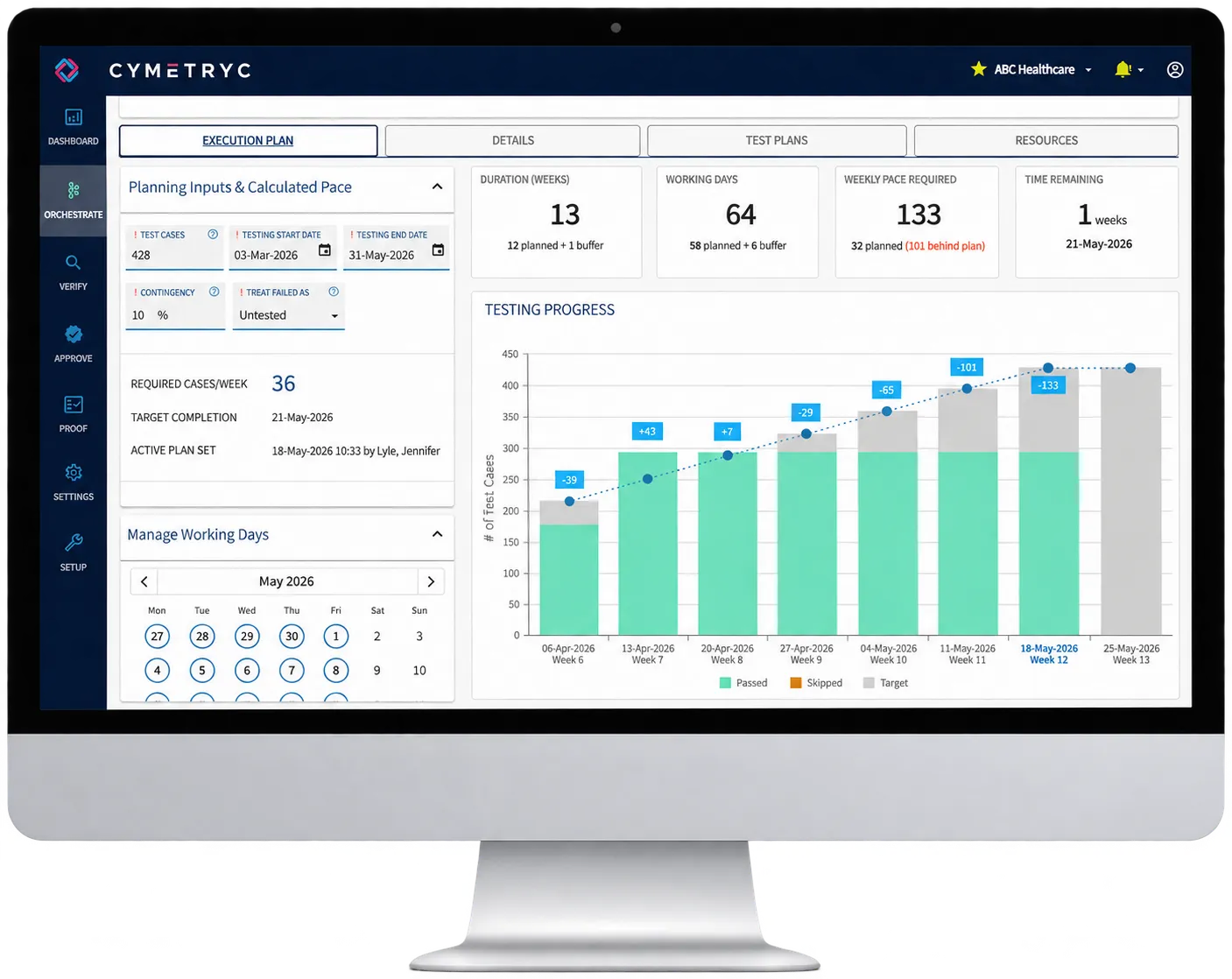
In a large Beaker implementation, Cymetryc reporting does not just show that testing is "in progress." It shows the shape of the work. It shows how many events are underway, how many test cases and steps have been completed, how many remain, where failures are occurring and which areas are still untested or only partially complete.
That matters because there is a big difference between knowing that a project is busy and knowing where the project is actually exposed.
From event summary reporting, leadership can see where testing volume is concentrated, which workflows have the largest remaining effort and where progress is slowing. The report does not simply say "we have work left." It translates remaining work into something operational: testing units, estimated effort and the areas where additional support might be needed.
That is a very different kind of status conversation.
Instead of relying on someone to manually reconcile spreadsheets and summarize the week, the team can look at real testing activity and ask better questions. Which sections need more testers? Which workflows are producing the most failures? Which events are closest to completion? Which areas are not moving fast enough to protect the timeline?
Issue reporting adds another layer of visibility. Hundreds of issues are not floating around as disconnected comments, screenshots or meeting notes. They can be grouped by event, status and severity. The team can see which issues are new, which are in progress, which are waiting for more information and which are ready for retesting.
That "ready for retesting" view is especially important. It shows whether the project is actually closing the loop. In a manual process, retesting can become a side note, something tracked by memory or buried in another spreadsheet. In a controlled validation process, retesting becomes part of the evidence trail.
That is the difference between activity and control.
At Beaker scale, visibility is not a dashboard luxury. It is a project necessity. It gives the customer a clearer view of where the work stands, and it gives Epic and the broader implementation team more useful information about where issues are clustering and what still needs attention.
Most importantly, it turns validation from a subjective status update into operational data.
That is how teams begin to manage the avalanche instead of simply reacting to it.
We have seen this same pattern in other Beaker work as well. In one 11-hospital health system implementation, approximately 14,000 lab test scripts were identified for documented testing. The project involved 50 subject matter experts plus dozens of additional laboratory participants. The testing had to cover workflows across the organization, out to the EHR, to analyzers, connected reference laboratories and more.
That is not routine UAT.
It is a major clinical, operational and regulatory effort.
It includes in-range and out-of-range testing, dilutions, middleware rules, auto-validation rules, QC, repeats and reruns, complex microbiology workflows, cancellations, problem specimens, specimen tracking, specimen transfer and integration to upstream and downstream systems.
Every analyzer is touched.
Every connected device matters.
Every result pathway needs confidence.
And all of it sits on top of the laboratory's normal workload.
This is why the old way breaks down. Spreadsheets were never designed to manage thousands of test cases, tens of thousands of steps, hundreds of issues, multiple approval paths and regulatory documentation at the same time. Shared drives were never designed to prove traceability. Email threads were never designed to manage retesting. Manual status updates were never designed to provide operational control.
At this scale, the question is no longer whether the team can work harder.
They already are.
The question is whether the organization can see the work clearly enough to manage it.
That is the real lesson of the avalanche. Large-scale Beaker validation does not just require execution. It requires control over scope, evidence, issue resolution, retesting, approvals and the remaining work still ahead.
Without that control, teams may still make it to go-live. But they may arrive exhausted, uncertain and carrying more risk than they realize.
With it, the conversation changes. Instead of spending every meeting trying to determine where things stand, teams can ask better questions. Where do we need to shift resources? Which workflows need intervention? Which issues are threatening the timeline? Which areas are ready for review? What still needs evidence before we can close?
That is what modern validation should make possible.
Because the goal is not just to get through Beaker testing.
The goal is to get through it with confidence.
Confidence that the right workflows were tested. Confidence that the evidence exists. Confidence that issues were resolved and retested. Confidence that the laboratory can stand behind the validation record after go-live.
Epic Beaker implementations are not getting smaller. Laboratory teams are not getting more spare time. Regulatory expectations are not becoming lighter.
The avalanche is real.
The only question is whether teams will keep trying to manage it manually, or whether they will finally acknowledge that validation at this scale requires a different operational model.

Security & compliance
SOC 2
Type 2
ISO
27001:2022
HIPAA
Compliant
GDPR
Compliant