Login
Login
Book a Demo
Book a Demo



The New Rules of Enterprise UAT – Part 1
Most organizations still treat user acceptance testing as a familiar project milestone: something that happens near the end, confirms whether users can complete their workflows and gets managed through a mix of spreadsheets, status meetings, screenshots, shared folders and a heroic amount of follow-up. That approach may have been workable when enterprise software projects were fewer, systems were less integrated and configuration changes happened less often. But it is increasingly mismatched to the volume, complexity and risk that UAT now carries.
Today, health systems and other complex organizations are managing large portfolios of software work at the same time. It is not unusual for a health system to have hundreds of active projects in motion across clinical, operational, financial and administrative areas. Some are large transformation programs. Others are upgrades, module rollouts, integrations, regulatory changes, workflow redesigns, new device connections, reporting changes or security updates. Each one may require some level of UAT, and the volume keeps growing.
Many of the most important systems organizations rely on today are not internally developed applications. They are highly configurable, third-party platforms: LIS/LIMS, EHR, Order Comms, PACS, middleware, blood bank, QMS, ERP, HRIS, Workday, revenue cycle, supply chain, reporting and analytics systems. These platforms support critical business, clinical, financial and operational workflows, and they rarely operate in isolation.
In these environments, the organization may not control the source code, but it is still responsible for proving that the system works correctly in its real-world environment. That means validating configuration, workflows, integrations, data movement, user roles, security permissions, approvals, exceptions, reports and downstream impacts. For regulated, clinical or business-critical systems, the stakes are even higher. If an LIS or LIMS workflow is wrong, patient results may be affected. If Order Comms does not route correctly, the downstream impact can be significant. If PACS access, routing or reporting workflows are not validated properly, clinical operations can be disrupted. If Workday roles, approvals or payroll-related configuration behave unexpectedly, the problem may not be visible until employees, managers or finance teams are already affected.
That is the core reason UAT has become so much more important than a late-stage sign-off exercise. In highly configurable third-party systems, the vendor provides the platform, but the customer must prove that the implemented system is ready for its users, workflows, data, integrations and operating environment.
There are established maturity models for software testing, software development quality and project governance. Those frameworks are useful, but most were created with software development organizations in mind. They focus on improving testing discipline, defect prevention, test automation and the broader software delivery lifecycle.
Enterprise UAT for configurable third-party software is a different problem. In many cases, the organization is not testing code it wrote. It is testing whether a purchased and configured system works correctly for its own business rules, workflows, users, data, integrations and operational realities.
For something so important, UAT remains surprisingly under-examined. Many organizations have inherited a UAT process rather than intentionally designed one. They may have templates, trackers and project rituals, but not necessarily a maturity model for understanding whether their UAT process is fit for the volume, complexity and risk it now carries.
That gap matters because the question is no longer simply, "Did the software pass testing?" The better question is, "Have we proven that this system is ready to operate safely, accurately and effectively in our environment?"
The familiar UAT toolkit has not kept pace with the work now being asked of it. Many teams are still relying on spreadsheets to track test cases, shared folders to store screenshots, email threads to discuss issues, meetings to gather status, manual follow-up to chase approvals and copy-and-paste work to assemble final documentation.
This can work for a small project with a small team and a low-risk system. It becomes fragile when the project involves multiple sites, departments, workflows, vendors, interfaces, approvers and regulatory expectations. It becomes even more fragile when the same organization is managing dozens or hundreds of technology projects at the same time.
The issue is not that people are careless. In most organizations, the opposite is true. Project managers, analysts, testers, clinical SMEs, business users and approvers are working extremely hard. The problem is that the process was never designed for the current volume, complexity and risk.
This is why UAT needs its own maturity conversation. Not just software testing maturity. Not just QA maturity. Enterprise UAT maturity.
For highly configurable, business-critical and regulated third-party software, UAT is where the organization proves that the system is ready for real-world use. A mature UAT process gives leaders confidence that the right workflows were tested, the right people performed the testing, the right evidence was captured, failures were documented, issues were assigned and resolved, retesting occurred where needed, approvals were completed by the appropriate reviewers and final documentation can stand up to operational, audit or regulatory review.
That kind of confidence does not come from a spreadsheet alone. It comes from structure, visibility, reuse, intelligence and continuous readiness.
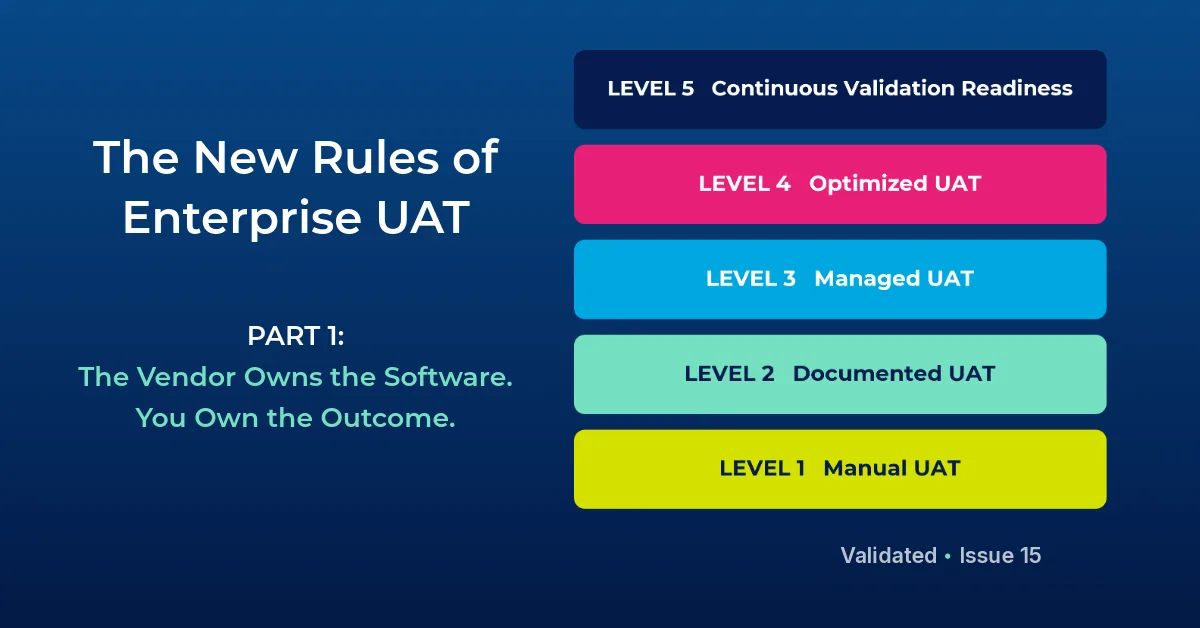
The Enterprise UAT Maturity Model is a practical framework for understanding how organizations move from manual, project-by-project testing toward a more repeatable, visible and intelligent UAT capability.
The more risk a system carries, the more mature its UAT process needs to be.
Said another way, organizations mature through structure, visibility, reuse, intelligence and continuous readiness.
At the earliest stage, UAT is dependent on individuals, spreadsheets, screenshots and memory. At the next stage, testing becomes more documented, but still heavily manual. As maturity improves, UAT becomes centralized, visible and easier to manage across teams and workstreams. Over time, organizations begin to reuse testing assets, apply risk-based planning and improve the quality of test design. The most mature organizations move toward continuous readiness, where UAT is not reinvented for every project. Instead, it becomes a reusable enterprise capability that supports faster, safer and more confident change.
The pace of change is not slowing down. Enterprise applications are more configurable. Systems are more integrated. Vendor upgrade cycles are more frequent. AI-enabled workflows are emerging. Health systems, laboratories and large enterprises are under pressure to modernize while operating with constrained resources.
At the same time, the consequences of poorly validated change are becoming harder to absorb. A missed configuration issue may affect a clinical workflow. A failed integration may disrupt operations. An incomplete approval trail may create audit exposure. A poorly tested enterprise application may damage trust with employees, customers, clinicians or patients.
UAT can no longer be treated as a late-stage checklist. For business-critical systems, UAT is one of the last controlled opportunities to find problems before they become operational problems.
The next time a major system is ready for go-live, the question should not be, "Did everyone finish their spreadsheet?" The better question is, "Do we have real confidence that this system has been tested, evidenced, reviewed and approved for the way our organization actually works?"
That is the heart of Enterprise UAT maturity, and it is where this series will begin.
Next in the series: Part 2: Manual UAT Does Not Scale

Security & compliance
SOC 2
Type 2
ISO
27001:2022
HIPAA
Compliant
GDPR
Compliant